Buying property in Telangana is a significant investment, but it is often complicated by the presence of “prohibited properties”. These are specific land parcels restricted from sale, purchase, or registration by the state government due to legal, administrative, or policy-related reasons. Under Section 22-A of the Registration Act, 1908, the government is empowered to block transactions that are deemed opposed to public policy.
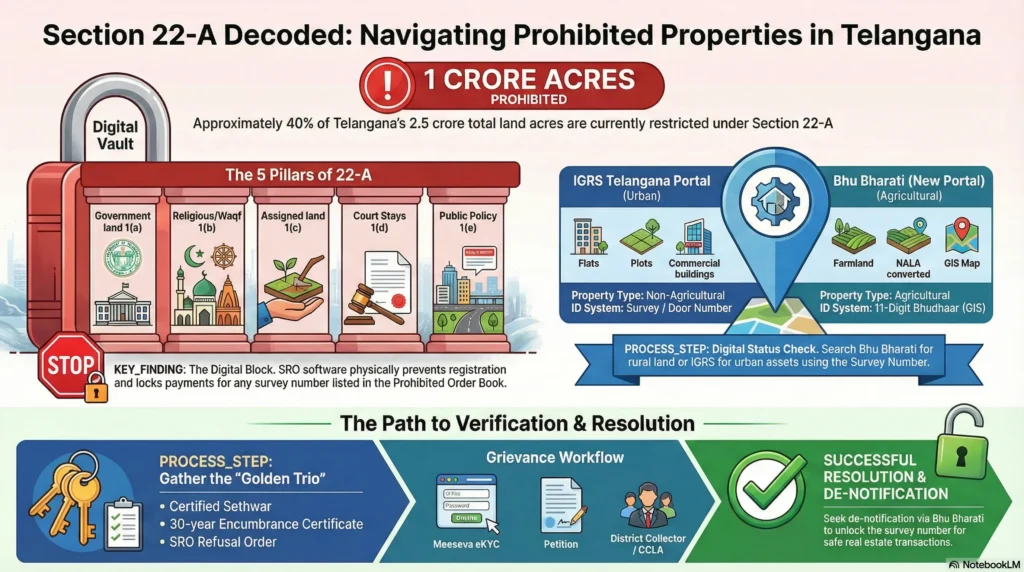
What are Prohibited Properties in Telangana?
Understanding Section 22-A of the Registration Act
Section 22-A is a legislative provision that authorizes the state government to notify certain documents or classes of documents as prohibited for registration. In Telangana, this creates a digital “lock” on the property records, physically preventing the Sub-Registrar (SRO) from processing sale, gift, or mortgage deeds for that survey number.
Why Your Property Might be Flagged
The primary intent of these prohibitions is to protect public assets, prevent the illegal sale of social welfare lands, and safeguard religious or communal properties. However, since the 2017-18 Land Records Updation Programme (LRUP) and the 2020 Dharani rollout, many private “Patta” lands have been mistakenly included in these lists due to outdated records or digital migration glitches.
The 5 Major Categories of Prohibited Land (Section 22-A Breakdown)
22-A(1)(a): Government & Poramboke Lands
These include lands belonging to the state, central government, or local authorities, often referred to as ‘Sarkari’ or ‘Poramboke’.
22-A(1)(b): Religious, Endowment & Waqf Properties
This clause protects properties owned by the Endowments Department (temples) or the Waqf Board (mosques and charitable trusts) to prevent unauthorized resale of community assets.
22-A(1)(c): Assigned Lands & The 1954 Cut-off Rule
Assigned lands are distributed to the landless poor for cultivation or housing. Under the 1977 Act, these are non-transferable. However, lands assigned prior to June 18, 1954, often do not carry these restrictions, yet they frequently remain flagged in the system.
22-A(1)(d): Court Stays & Active Litigation
Properties under active litigation or specific prohibitory orders from the High Court or civil courts are automatically blocked to prevent further alienation.
22-A(1)(e): Public Policy & Ceiling Surplus
This includes lands the government deems “unfit” for private transfer, such as ceiling surplus lands or environmental protection zones.
How to Check Prohibited Property Status Online
Bhu Bharati Portal (Agricultural Records)
Bhu Bharati is the official Integrated Land Records Management System (ILRMS) launched under the Telangana Bhu Bharati Act, 2025. It is the successor to the Dharani portal.
Step-by-Step Search:
- Visit the Bhu Bharati website.
- Click on “Land Details Search” in the Information Services section.
- Select your District, Mandal, and Village.
- Search by Survey No. or Pattadar Passbook Number.
- Check the “Prohibited Status” (నిషేధిత స్థితి) column.
IGRS Telangana (Urban & Non-Agricultural Assets)
For flats, commercial spaces, and urban plots, the IGRS portal remains the primary database.
- Go to registration.telangana.gov.in.
- Click the “Prohibited Properties” link.
- Enter the District, Mandal, Village, and Survey Number.
- Look for a Red indicator or a specific clause like “Under 22-A 1(a)”.
Latest Updates: GO Ms No. 98 and the 2025 Overhaul
The High-Level Committee Review
In August 2025, the government issued GO Ms No. 98, forming a three-member high-level committee to review the prohibition list covering over one crore acres. The committee includes the Chief Commissioner of Land Administration (CCLA) and a retired district judge.
Public Objections and the 12-Column Proforma
The government is mandated to publish updated lists and invite public objections using a 12-column proforma before finalizing the list under Section 22-A.
How to Remove a Property from the 22-A Prohibited List
Filing an Online Grievance
Landowners can file a grievance via the Bhu Bharati Citizen Portal.
- Mandatory Step: After submitting the “Grievance relating to inclusion in Prohibited Properties List,” you must visit a Meeseva center for biometric eKYC verification.
Applying to the District Collector
For complex cases, such as historical Patta status, owners must apply to the District Collector with the “Golden Trio” of documents:
- Certified Sethwar or Diglot (historical classification).
- Encumbrance Certificate (EC) showing transactions over 30 years.
- SRO Refusal Order.
Legal Remedies and RTI Strategies
If the Revenue Department fails to act within 90 days, the High Court can be approached for a Writ of Mandamus. Additionally, filing an RTI application can help obtain internal memos and hold officials accountable for delays.
Investment Risks & Banking Realities
Why Banks Reject Loans
Banks consider 22-A properties to have “non-marketable titles”. Since a mortgage cannot be legally registered at the SRO, the property cannot serve as collateral.
Impact on NALA (Land Conversion)
A prohibited status prevents agricultural land from being converted for residential use (NALA).
Frequently Asked Questions (FAQs)
What is the difference between “Locked Land” and “Prohibited Land”?
Prohibited land is a legal status under Section 22-A, while “Locked Land” is often a temporary administrative hold for pending verification or investigations.
Can assigned land be sold after 20 years?
No. Under current Telangana law, assigned land remains non-transferable unless officially regularized by the government.